Walking the tightrope: The DSA and Jacobin

Send to Printer, PDF or Email
[Note: This article was originally published in the Weekly Worker, March 22, 2018,
https://weeklyworker.co.uk/worker/1195/walking-the-tightrope/.  See also the author's previous article on the politics of Michael Harrington, a founder of the DSA; The left wing of the permissiblehttp://forum.permanent-revolution.org/2017/09/the-left-wing-of-permissible-politics.html]


By Jim Creegan

When - to the astonishment of many in the Second International, including Lenin - Karl Kautsky refused to denounce the German Socialists in the Reichstag who voted war credits to the kaiser on that fateful day of August 4 1914, there were some members of the German Social Democratic Party (SPD) for whom their leading theoretician’s betrayal of the Second International’s anti-war pledges did not come as a bolt from the blue.

Four years earlier, in 1910, Kautsky found himself on the horns of a dilemma. The kaiser’s government had banned an SPD demonstration for a more democratic Prussian electoral system, scheduled to take place in the Treptow district on the southern edge of Berlin. But instead of assembling there and confronting the police, the party secretly directed its members to gather in the centre of the city, in the Tiergarten, near the Reichstag. The 150,000 workers who answered the call threw the ruling class into a state of virtual panic. Rosa Luxemburg and her followers on the SPD left saw this demonstration, combined with growing worker discontent over falling wages, as an opportunity to build a more powerful revolutionary movement, possibly by expanding the protest into a mass strike.

The party’s reformist right wing, on the other hand, took fright, along with the bourgeoisie. They fretted that such anger in the streets might endanger the support of bourgeois parties for the passage of a tepid suffrage-broadening bill and hurt their chances in an upcoming Reichstag election by scaring off more moderate provincial voters. Kautsky, while still attempting to steer a middle course between left and right, came down substantially on the side of the parliamentarians. He emphasised the primary importance of elections, branded advocacy of a mass strike adventurist, and refused to allow Luxemburg’s dissenting views to be published in Die Neue Zeit, the party monthly he edited. From this time forward, Kautsky was inclined to regard Luxemburg and her revolutionary cohort, as opposed to Eduard Bernstein and the reformist right, as his main adversary within the SPD.

The question posed by this dispute was not the worthiness of the fight for electoral reform. Both Kautsky and Luxemburg supported this elementary democratic demand. The argument was over whether the struggle for reform should be conducted by revolutionary methods - ie, principally by extra-parliamentary mobilisations, possibly broadening into a struggle for power - or by reformist means: hoping the ruling class and their political parties could be persuaded to grant greater democracy by assuring them that such a reform did not pose a revolutionary danger.

Only a year earlier, Kautsky had taken up the cudgels against the SPD’s leading right ‘revisionist’, Eduard Bernstein, in The road to power,regarded as his most revolutionary work. In itKautsky refutes Bernstein’s argument that the goals of revolution and proletarian dictatorship had been rendered obsolete by parliamentary democracy and the steady progress of reform. He reaffirms the conquest of political power by the proletariat to the exclusion of all other classes, and the complete abolition of private property in the means of production, as the party’s historic mission.

Kautsky, however, is inclined to relegate the accomplishment of this mission to a far-off day. Only after the achievement of a series of democratic reforms - the SPD’s minimum programme - would the question of the conquest of political power and the socialisation of the means of production - the maximum programme - present itself. By fighting for democratic reforms, writes Kautsky, workers increase their combativity and political consciousness. He thinks that a revolutionary conjuncture is most likely to occur as a result of the bourgeoisie’s panicked and violent reaction against the steady accretion of working class trade union and electoral strength, which would force the proletariat to respond in kind.

It may be fairly said, in light of historical experience, that Kautsky gives far too little weight to the possibility that the line of working class advance could be more jagged and contradictory than his tidy, incremental prognosis anticipates. The working class can suffer major defeats. And, while it is true that the fight for reform can be a prelude to revolution, and hence completely compatible with the ultimate goal, the imperatives of reform and revolution can also collide. What if liberal allies demand disavowal of revolutionary means in return for their support for reform measures? And what if, as in the crisis described above, events occur out of sequence, and the masses (not having read Kautsky) begin to take potentially revolutionary steps before the reform agenda has been completed? Will not many of their leaders, having become accustomed to the pacific routines of election cycles and collective bargaining during a prolonged reformist period, regard such mass initiatives as unwelcome disruptions of their expectations of orderly progress, and hence denounce them as ‘anarchy’? Kautsky was one such leader. Facing the unanticipated dilemma of 1910, he chose parliamentarism over mass protest, arguably taking the first step on the road to the infamy of August 1914.[1]

We live today under circumstances vastly different from those of workers and socialists in the Kaiserreich Germany of over a century ago. An improvement in material conditions has been accompanied by a severe contraction of the realm of possibility. There is no militant mass workers’ movement in any western country, and today’s question is whether or not any significant progressive reforms are even attainable, let alone whether the power of capital can be broken. With industrial and trade union struggles at an historic low, people are expressing their anger over declining living standards and social marginalisation in what they see as the only place left to them: the electoral arena. Although more of that anger is finding an outlet in support for fascistic, rightwing politicians than for the thoroughly reformist left that stands at the opposite pole, that pole is growing too. The fact that the horizons of its principal figures - Corbyn, Mélenchon, Sanders - are limited to hustings and parliamentary benches should not lead those of us on the left of the left - who dismiss as unrealistic the main reformist goal of restoring the post-World War II welfare state - from appreciating the significance of this voter rebellion, interrogating its possibilities, and attempting to steer it to the left. And it is in the course of such an interrogation that the old questions of reform or revolution inevitably resurface, albeit in less urgent ways.

New day
In the US, the principal left beneficiary of the 2016 presidential campaign of Bernie Sanders is Democratic Socialists of America (DSA), whose membership has swelled from about 6,000 to 30,000 since the presidential election, and now has about 300 chapters throughout the country. Eighty percent of its 24,000 new members are under 35. The organisation is 90% white and 75% male. The influx of new members has given the group a somewhat different complexion from the pale pink, Democrat-loyal outfit founded in 1982 by America’s then leading social democrat, Michael Harrington, from a merger between his own followers and rightward-moving remnants of the 1960s new left.[2]

Organisationally diffuse and politically amorphous though today’s DSA certainly is, its youthful new members are showing distinct signs of leftward momentum. The 1,000 delegates who assembled for its Chicago convention this past August re-elected several of the Harringtonite old guard to the national political committee from among the various slates on offer, but they also voted to end the group’s affiliation to the Second International - which Harrington had worked hard to achieve. And in a repudiation of DSA’s founding principle of support for Israel, the convention decided to back the boycott, divestment and sanctions movement. There was reported to be some sentiment among delegates for breaking entirely with the Democrats.

A demand was raised immediately after the convention for the expulsion of Danny Fetonte, who had not apprised the delegates who had just elected him to the national executive of the fact that he had earlier worked as a publicist for a police union in Texas. Although the executive failed to expel Fetonte, he resigned shortly after the scandal broke. Older members complained that Harrington would not have recognised the current organisation; younger ones - some of whom style themselves revolutionaries - said, the less recognisable, the better.

The organisation now stands somewhere halfway between its old social democratic self and the kind of leftwing big tent that Students for a Democratic Society (SDS) became in the 1960s. And like SDS, it is starting to become a magnet for other far-left groups that would not have touched it previously with a 10-foot pole, but who now have hopes of acquiring new recruits for themselves and/or influencing the direction of DSA as a whole. It is doubtful that a standing rule excluding members of outside democratic-centralist organisations will keep these entryists at bay.

The closest thing to a flagship publication of the DSA left is Jacobin - far and away the hottest new item on what exists of an American radical literary scene. Since its appearance as an online journal in 2010, and its 2011 debut as a printed quarterly magazine, it has acquired a circulation of 15,000, and claims over 700,000 unique monthly online hits. Although not officially a DSA publication, its founder and editor, Bhaskar Sunkara, is a vice-chairman of the group; and its managing editor, Seth Ackerman, is also a member. Its stable of writers and editors seem to be part of a DSA-ish, postgraduate student milieu. They see themselves as representing the thinking of a crop of younger Marxists, not defined by the questions that divided the left during the cold war.

Jacobin is Sunkara’s brainchild. In the short space of eight years, he has created a journal of high literary quality and striking graphic design. Its print and online editions regularly feature articles from amongst the brightest stars in the Anglophone left academic and journalistic firmament, and over 50 reading groups meet to discuss its contents. The editors have recently launched an allied analytical journal called Catalyst.This literary success has vaulted Sunkara into something like media celebrity status. He has become the subject of numerous interviews and a profile, as well as an op-ed piece, in The New York Times,the country’s newspaper of record; he is a sometime guest on at least one television talk show. All of the above is a remarkable achievement for a man of Sunkara’s 28 years.

Jacobin is nothing if not eclectic. It welcomes contributions by everyone from social democratic liberals to avowed revolutionaries. The first issues of Catalyst, for instance, feature articles by two self-declared Marxists, Mike Davis and Kim Moody, as well as a piece by Jamie Galbraith, an unabashed Keynesian liberal (and son of America’s foremost Keynesian, the late John Kenneth Galbraith). Indeed, Sunkara himself describes his project as an attempt to stake out some kind of middle ground between social democratic reformism and revolutionary Marxism. In a 2014 interview with New Left Review,he enumerates a few of his major intellectual and political influences:

One of them would definitely be Michael Harrington, even though we disagree with him politically. Those of us on the left wing of DSA often fight against a lot of Harringtonite ideas, like his softness toward the trade union bureaucracy and the Democratic Party … and I’d hope for a break with the Democrats much more than Harrington did. But, intellectually, I think he’s very much underrated as a populariser of Marxist thought …

Ralph Miliband is another important influence, because, more than anyone, he represented that middle ground … between Leninism and social democracy …
Some of us came from traditions inspired by Trotskyism, without ever quite becoming Trotskyists …[3]

Remarks like the above give rise to further questions. What are the precise coordinates of this middle ground in terms of historical affinities, current political choices and longer-term prospects? These questions could admit of no easy answers during the first few years of Jacobin’s existence. More recently, however, the outlines of a political profile are beginning to emerge amid the quarterly’s rich variety of articles and topics, and the tendency of its editors and leading writers to wax both revolutionary and social democratic.

Leaning left
In its more leftwing mode, the magazinehas gone some distance to divest itself of the most repellent features of social democracy. Absent from its pages is the reflexive anti-communism with which the Second International assured western ruling classes of its loyalty from November 1917 through the end of the cold war.

The lead article by Sunkara in last year’s Russian Revolution centenary issue is an accurate historical summary, which recognises the Bolshevik Party as a uniquely democratic formation, and Lenin and Trotsky as the passionate working class revolutionaries that they were. Sunkara specifically repudiates the standard bourgeois and social democratic portrayals of the Bolsheviks as conspiratorial, power-hungry demons. A cursory glance at Jacobin online will also reveal everything from a laudatory profile of Shapurji Saklatvala, Britain’s first communist member of parliament, to a recycled 1984 piece by Ralph Miliband and Marcel Liebman on the pitfalls of anti-communism.

Second, Jacobin rejects the old Harringtonian notion that the Democratic Party can be realigned into a social democratic formation through a politics of internal pressure. It proclaims its ultimate goal to be the formation of a mass-based labour party independent of both Republicans and Democrats.

Thirdly, Jacobin has followed DSA in disavowing any affinity with the so-called socialist parties of the Second International, which have presided over the imposition of neoliberal austerity.

And, finally, Jacobin asserts the need to go beyond the social democratic welfare state of the Scandinavian type. In a 2017 article, ‘Social democracy is good. But not good enough. They won’t let us keep the nice things’, authors Bhaskar Sunkara and Joseph Schwartz acknowledge that “achieving a stable welfare state, while leaving capital’s power over the economy intact, is itself far from viable”. They continue:

Since the early 1970s - the height of western social democracy - corporate elites have abandoned the post-war ‘class compromise’ … What capitalists grudgingly accepted during an exceptional period of post-war growth and rising profits, they would no longer.
The authors then go on to remind readers how the French and European ruling classes sabotaged French Socialist president François Mitterrand’s 1981-83 attempt to introduce radical Keynesianism in one country with a capital strike, and how the earlier Swedish Rehn-Meidner plan to tax capital, and eventually nationalise industry, was abandoned for fear of capitalist resistance. Schwartz and Sunkara’s conclusion: “To chart a different course, we would need a militant labour movement and a mass socialist presence strengthened by accumulated victories, looking to not merely tame, but overcome, capitalism.”[4]

Particularities
Yet, in addition to these general aversions and ambitions, one is inclined to enquire further concerning specific political strategies. Two recent articles provide the outlines of the thinking of Jacobin’s editors. An op-ed piece by Sunkara entitled ‘Socialism’s future may be its past’ in The New York Times this past summer speaks of three destinations for the future: “Singapore Station”, by which Sunkara means a globalist, neoliberal capitalism, with austerity and widened class division, presided over by an equal-opportunity, internationally-minded capitalist elite, anti-democratic, but open to anyone regardless of creed, colour or nationality. A second is dubbed “Budapest Station” - the return to a chauvinist, racist, go-it-alone, national capitalism now being offered by the likes of Hungarian prime minister Viktor Orbán and Donald Trump. The third - which Sunkara advocates - is “Finland Station”, the writer’s designation for pre-World War I social democracy, untarnished by either the betrayals that commenced in 1914 or the Bolsheviks’ post-1917 authoritarian drift, culminating in the gulag.
What kind of socialism would such a revivified social democracy aim at? According to Sunkara,

Some broad outlines should already be clear: worker-owned cooperatives still competing in a regulated market; government services coordinated with the aid of citizen planning; and the provision of the basics necessary to live a good life (education, housing and healthcare) guaranteed as social rights.
And how does Sunkara propose to attain this socialist goal? He envisions

a transition … that does not require a ‘year zero’ break with the present [ie, revolution - JC]. This time, people get to vote. Well, debate, deliberate and then vote - and have faith that people can organise together to chart new destinations for humanity.[5]
The above themes are further elaborated in ‘Our road to power’ in the Jacobin for autumn 2017. The article appears under the name of the New York University sociology professor, Vivek Chibber, but its format as a poster-like insert - combined with the fact that Chibber is the editor of Catalyst, published by Jacobin - would suggest that it is intended as something resembling a platform statement.

Here, Chibber argues that any socialist strategy for today “has to downplay the centrality of a revolutionary rupture, and navigate a more gradualist approach”. Revolutionary situations, he says, may emerge in the long run, but “For the foreseeable future, left strategy has to revolve around building a movement to pressure the state, gain power within it, change the institutional structure of capitalism, and erode the structural power of capital - rather than vaulting over it.” While acknowledging that a revolutionary outlook may have been realistic in the period between the two world wars, Chibber writes:

Today, the state has infinitely greater legitimacy with the population than European states did a century ago. Further, its coercive power, its power of surveillance, and the ruling class’s internal cohesiveness give the social order a stability that is orders of magnitude greater than it had in 1917.[6]
As to the shape of the gradually-arrived-at socialist future, Chibber avers that “the burden of proof” is on those who would argue that a planned economy of any kind might work and that “… we might seriously have to consider that the possibility that planning as envisioned by Marx might not be a real option …”, and, “given the dubious record of central planning, … that a post-capitalist economy might have to take the form of some sort of market socialism”:

… it will be different from capitalism in that:
  •  The market will be constrained, so that it isn’t the arbiter of people’s basic well-being.
§   Economic decision-makers will be democratically accountable.
§   Wealth inequalities will not be allowed to translate into political inequalities.[7]

Absence of argument
So here we have it: parliamentary gradualism, leading to a market socialism, combined with strong welfare-state protections.

What is so striking here is not the assertions of strategy and goals by these two writers, but the complete absence of any sustained supporting argumentation. Sunkara and Chibber may, for instance, have tried to explain why the undoubtedly greater stability of post-war capitalism has made it any more amenable than before to legalistic attempts at deep structural reform. Does not the fate of such endeavours - from Allende’s Chile in the 70s, to Mitterrand’s France in the 1980s (cited elsewhere by the authors themselves) - point to the conclusion that the ruling classes, faced with what they consider unacceptable legislative challenges to their wealth and prerogatives, will respond with economic sabotage, and ultimately with deadly force?

They may also have asked themselves why reformist strategies have suddenly become more viable in a period when the bourgeoisie is on the offensive against the remaining pillars of the welfare state, and, at least in the US, is so puffed up with arrogance as to consider attempts to defend, let alone extend, these gains as tantamount to communism. It seems to elude them that the post-war class compromise, while partly due to popular struggles and an economic boom that made it affordable for the capitalist class, was also part of a quid pro quo.Social democratic parties and unions were given ‘a seat at the table’, partly in exchange for their loyalty and cooperation in combating the ‘Soviet threat’. One does not have to be an apologist for Stalinism to understand that the Soviet Union and its allies were non-capitalist, and hence became the object of a global anti-communist crusade, in the service of which the western ruling classes were willing to make broad concessions; after the collapse of the Soviet Union, they became more determined to take them back.

The rejection of the idea of a planned economy, moreover, seems premised entirely on the equation of planning with the failed bureaucratic Soviet model. Are not other, more democratic forms of planning possible, such as, for instance, planning under workers’ control, in which a national plan for the ‘commanding heights’ of the economy would be executed by workers invested with broad powers of implementation at the workplace, including the right to elect and dismiss their managers and supervisors? Can the market be used in such a system to register consumer preferences without determining the fate of entire enterprises and their employees?

Chibber argues that the only alternative to complete top-down planning is worker cooperatives, whose production is regulated, and whose viability is determined, by nothing other than market vicissitudes, with continued anarchy of production as a result. Chibber thinks it possible to prevent the economic inequalities - which he seems to acknowledge will occur when less profitable firms succumb to the stronger - from becoming political inequalities. But how, exactly? Through laws and government regulations, which have never succeeded before in preventing the economically powerful from becoming politically dominant.

The failure of Sunkara and Chibber to tackle important questions like the ones above indicates that the combination of gradualism and market socialism they espouse represents more of a political sensibility - the crystallisation of certain contemporary left political moods - than a considered theoretical weighing of objective possibilities and constraints. This sensibility is compounded of the naivety of newly politicised youth and the pessimism of an older generation, borne of past failures and defeats. It is only to be expected that young people awakened to politics by the Sanders campaign will bring with them to DSA a slightly more radical version of the electoral politics espoused by the candidate they supported, according to which it is possible to restore Roosevelt’s ‘new deal’, and that the road to such a restoration - and perhaps something even more radical called socialism - lies along the path of electing candidates who denounce corporate power and promise to enact progressive legislation.

Nor is it surprising that conscious Marxists - perhaps chastened by the failures of revolution in the last century, as well as the bankruptcy of past efforts to organise various ‘revolutionary vanguards’ in advanced countries - should seek to accommodate the spontaneous reformist consciousness of the politically aroused young, as well as invent reformist scenarios of their own. The steady drumbeat of bourgeois propaganda since the collapse of the USSR, to the effect that the market is the only conceivable effective regulator of economic activity, has also taken its toll. Sunkara and Chibber appear to have abandoned the fundamental Marxist idea that the forces of production can be brought under conscious control.

‘Splitting the difference’
How, more specifically, does Jacobin view the transition from social democratic-type reforms to full socialism, and its relation to American electoral politics and the Democratic Party? Several interviews with Sunkara supply a few hints. When asked by New Left Review if there was a “tension between the social democratic and radical socialist perspectives” being offered by Jacobin, Sunkara replied:

One day, in a dream scenario where you have a socialist movement pushing for full social ownership, say, and it’s encountering active opposition from the bourgeoisie, then you would have a clash. But that debate is very much in the future.[8]
Sunkara himself seems aware of the historical affinities such remarks suggest. One interviewer writes:

Trying to get more of a handle on his politics, I asked Sunkara to pick between Eduard Bernstein - the incrementalist German Marxist who sowed the seeds of modern social democracy - and Rosa Luxemburg, who assailed Bernstein for abandoning hope of revolution. “Kautsky,” he answered, naming Bernstein and Luxemburg’s contemporary who split the difference between the two. “Maybe more Luxemburg.”[9]
We have seen how Kautsky ‘split the difference’: by endorsing reformism now, and consigning the prospect of socialist revolution to a vaguely distant future. Sunkara’s remarks on political strategy seem to partake of the same approach. He says in an interview with Workers’ Liberty:

We should organise as much as we can outside the Democratic Party. A combination of building of the social forces of the left, and objective social conditions, will at some point lead to the fracturing of the two-party system … I would hope that one of the parties left standing will be a labour-backed, broad-left party with anti-capitalist currents … On the other hand, I have no hesitation in saying that I would have voted for Hillary Clinton in a swing state. There’s a certain vision of independent political action on the left that can constrain our tactical flexibility … in the Democratic Party there are certain races where I’d vote for a progressive Democrat - or even, in the case of a national election, in a swing state, for a Clinton-type Democrat …[10]
Sunkara assures the same interviewer: “I fully support Bernie Sanders. I have criticisms of him, but, when I campaign for him, I am fully and earnestly campaigning for him.” Even more revealing of Sunkara’s solicitude for reformist politicians are his remarks on Greece in another interview:

I appreciate the situation that Tsipras and the Syriza leadership found themselves in and that they accepted the latest austerity package begrudgingly and in generally good faith. They did not sell it as a victory, which is important. I reject the use of ‘betrayal’ to describe the actions of the leadership.[11]
This incidental remark is perhaps most troubling of all. Sunkara here does further homage to Karl Kautsky, who rejected the use of ‘betrayal’ for the Reichstag vote of the German Social Democrats in 1914. We can only add that if voting credits for a war one had previously pledged to oppose with a general strike, or implementing crushing austerity measures that one was elected to oppose, are not instances of betrayal, the word has no meaning.

Electoralist gradualism
In the early crisis of German social democracy described at the beginning of this article, the difference between revolutionary and reformist practice was starkly revealed. Rosa Luxemburg by no means denied the importance of reform struggles, but regarded them as a means to expand and deepen the mobilisation of the working class in preparation for the conquest of power. Kautsky, on the other hand, did not disparage mass mobilisations as such, but viewed them as an auxiliary to the party’s main electoral and legislative efforts, to be curtailed when they threatened to upset the parliamentary applecart.

The question of reform v revolution is not immediately posed by anything taking place in the US today; one can thus support Democratic candidates and participate in mass demonstrations without contradiction. It acquires more than theoretical importance to the extent that what the left does has consequences. And we can see the consequences of reformism in at least three instances in the 20th century: Allende’s Unidad Popular, Mitterrand’s Socialists, and Tsipras’s Syriza. In each of these cases the working class and its allies were led to the brink of a class confrontation by parties that had adopted a purely electoral strategy, and were unable and unwilling to mount the organised mass initiatives necessary to counter the economic sabotage and/or armed violence of the bourgeoisie. Allende, to his credit, died fighting back, gun in hand. The other two - Mitterrand and Tsipras - turned their coats to become the agents of capitalist austerity.

Jacobin editors are fond of Michael Harrington’s metaphor that pictures socialists walking a tightrope between ultimate goals and present possibilities. Less charitably, they can be said to be sitting on the fence between reformism and revolutionary Marxism. They wish to appeal to those on their left by disavowing social democracy’s more sordid historical chapters of class treason and current neoliberal complicities, while at the same time taking care not to give offence to the prevalent electoral-reformist consciousness of newly awakening political youth and old-school social democrats.

It is understandable that Jacobin wishes to avoid the fate of the various ‘revolutionary’ sects that are programmatically pure and numerically insignificant. To the extent that DSA is becoming more of a broad, leftwing umbrella than a decidedly social democratic organisation, it would be folly for revolutionaries to approach its new members with nothing more than an injunction to quit DSA and join their minuscule grouplets. One should, however, engage them with a view to bringing about a political differentiation from the hardened pro-Democratic Party reformists who still constitute an influential internal presence and sit on its national and local executives. To this end, one would seek to conduct political education in revolutionary history, and push for a number of programmatic proposals, such as no support for mainstream Democrats or the ‘progressive’ Democratic candidates who promise to endorse mainstream ones if they lose in primary contests.

Unfortunately, Jacobin is doing little along such lines. In terms of practical orientation, it simply reflects the amorphousness of the current DSA, rather than an attempt to give it a clearer political shape. Sunkara recommends that the left keep doing what most of it already does: support both independent candidates and ‘progressive’ Democrats, as circumstances permit, and continue to vote for mainstream Democrats, wherever the Republicans have a chance to win, with the hope that the opportunity for an independent, mass workers’ party will present itself due to altered circumstances some time in the future. In terms of longer-term strategies and goals, Jacobin,despite the more radical pronouncements and authors to be found in its pages, promotes a classical social democratic orientation that rejects any notion of a ‘rupture’ in favour of an electoralist gradualism aimed at penetrating and restructuring the existing state.

The above prescriptions do little to prepare for the tremors that are already beginning to unsettle an American-dominated world system in decline - one which may throw the tightrope-walkers off balance, and confront them with choices like the ones Luxemburg and Kautsky had to make over a century ago, much sooner than they think.

Notes


[1] This is a condensed version of events described in Carl Schorske, German social democracy, 1905-1917 chapter 7, London 1955.
[2]   See ‘The left wing of the permissible’ Permanent Revolution, Sept 23, 2017, http://forum.permanent-revolution.org/2017/09/the-left-wing-of-permissible-politics.html
[3]   New Left Review November-December 2014, https://newleftreview.org/II/90/bhaskar-sunkara-project-jacobin
[4]   All quotations from the Jacobin blog, https://www.jacobinmag.com/blog
[7]   Ibid.
[8]   New Left Review November-December 2014, https://newleftreview.org/II/90/bhaskar-sunkara-project-jacobin
[9]   D Matthews, ‘Inside Jacobin: how a socialist magazine is winning the left’s war of ideas’ vox.com March 26 2016, https://www.vox.com/2016/3/21/11265092/jacobin-bhaskar-sunkara
[10]  ‘The horizon of socialism’ Workers’ Liberty August 24 2017, http://www.workersliberty.org/story/2017-10-16/horizon-socialism-interview-bhaskar-sunkara
[11]   Roar magazine, January 4 2016.

Share:

Some thoughts on Weinstein

Send to Printer, PDF or Email

by Frank Brenner

The following was written back in November, shortly after the Weinstein scandal broke. It doesn't engage with many of the issues about #MeToo that have come up since then. I'll be posting another article that goes into some of that later. Still I think this article offers some insights into the current state of play of sex and social life.

Michel Houellebecq


The French writer Michel Houellebecq argued that neo-liberalism had “extended the domain of the struggle” into sexuality. By which he meant that just as economically the system was creating unprecedented inequality, the same was becoming true in sexuality. The permissiveness inaugurated by the Sixties didn't result in a sexual paradise for all. Quite the contrary, for a great many people things didn't get any better and often they got worse. The normalizing of sexual promiscuity worked mostly for those with good looks, money, power, celebrity or any combination thereof. And also mostly for men. For the outcasts – the ugly, the old, the poor, the mentally wounded, the nobodies – there was/is little opportunity for anything resembling sexual satisfaction. Except for porn. And even that is mostly for men. 40 percent of women and 30 percent of men are getting no sex at all – staggering numbers which attest to a schizophrenic divide: publicly we are sexually liberated but privately lots of people aren't a whole lot better off than the Victorians.

(And one should add that despite the ubiquity of 'hookup' culture among millenials, this generation is actually having less sex than its predecessors, indeed probably the least amount of sex since the oppressively conformist Fifties. For a sombre account of the emotional wasteland of contemporary sexuality, see Emily Witt's memoir, Future Sex.)

This isn't meant as a defense of traditional conformity. Rather it's to underscore the point that if you try to fix things within capitalism they inevitably get fucked up, twisted into a new form of oppression.

Much more could be said about the many ways in which sex, bodies and images of bodies have been commercialized and consumerized. Permissiveness is now the new conformity, in its own way as oppressive as its predecessor, as writers from Marcuse to Zizek have pointed out. It's a vast subject. My point about Weinstein is that I think his downfall signals a change. The extension of the domain of struggle is hitting its limits. Again there is a striking parallel with the economy: just as capitalism is crumbling without any obvious alternative emerging, so too with the 'political economy' of sex.

Weinstein epitomizes that economy. He gorges himself on young, attractive female bodies in the same vampirish way that capitalists are addicted to profit. Of course in Weinstein's case sexual exploitation is tied directly to his economic role as a movie producer. He profits in a double sense, and it's hardly a big stretch to conceive of his female victims as a sexual proletariat. That he is a bully in the boardroom as well as a predator in the bedroom reinforces the parallel.

(A small aside about language. In the last twenty or thirty years, it's become commonplace to speak of 'hitting on' women. We don't talk much about seduction anymore or flirting – those terms seem to belong to a bygone era. This use of language is a telling sign of the coarsening and brutalizing of sexual relationships. First you 'hit' on a woman and then you 'bang' her. We have gone from Casanova to Howard Stern.) 
Casanova
Of course the euphemism of the casting couch has always been a sick joke masking sexual violence. But if there is something distinctive about the current crop of Hollywood moguls like Weinstein, it is their level of hypocrisy. The old studio bosses didn't have to pretend to be feminists. But maybe hypocrisy and pretend aren't exactly the right words. Pundits like Thomas Frank explain Weinstein as a case of blatant hypocrisy, but I think this is too simplistic. I don't think Weinstein was just a predator in liberal/feminist clothing. For one thing I don't think he could have produced the quality of films he's made – films that often had a critical edge, including about sexuality – without some commitment to the progressive ideas he espoused. A blatant hypocrite would have just been a hack. I think the divide in such a person runs deeper, just as it does in the culture as a whole. Steve Jobs thought of himself as a revolutionary who was changing the world for the better – not as a brutal taskmaster running a global army of sweatshop labor. And he had millions of fans who saw him the same way he saw himself. This is not just hypocrisy, though it is partly that. It is also ideology: in a world where There Is No Alternative, where utopia is dead, being the best capitalist you can be is not just good for you but good for the world. You are not a ruler exploiting wage slaves but an innovator forging the way to a brighter tomorrow. You are a 'visionary', a 'disruptor', a 'creator' – and everyone knows that 'creative' people are not bound by the moral constraints that apply to ordinary folk. Again this might look like hypocrisy when written with scare quotes but it looks very different when you and everyone around you buy into this. When, for example, a world famous actress publicly addresses you as god.

The writer Lucy Preeble seems to me to strike the right balance in assessing Weinstein, whom she briefly worked with: “Weinstein has become a public monster overnight. But he’s not a monster, he’s a man. Today’s monster is yesterday’s ‘character’. And I could easily have liked him (it’s important to say that you can be harassed by people you like). Hollywood is run on charm as well as tantrums. There are elements of machismo that are glorified as an eccentricity of showbiz power ... In the arts, professionalism can be interpreted as a sort of inauthenticity, and those who can’t control themselves are seen as more ‘instinctive’. To be dangerous is to be artistically daring, particularly for men. Sometimes I wonder if being in the ‘feelings business’ pushes weak men to over-compensate with swearing, stunts and sexual conquest.”

But Thomas Frank is right to call out the insidious role of what he terms the “creative class”, i.e. “well-heeled executives in industries like Wall Street, Silicon Valley and Hollywood” for whom “modern-day liberalism is a way of rationalizing and exercising class power ... This is a form of liberalism that routinely blends self-righteousness with upper-class entitlement. That makes its great pronouncements from Martha's Vineyard and the Hamptons.” The Clintons are the great exemplars of this kind of liberalism, as is Obama, whose ties to Weinstein include having his daughter intern at Weinstein's company. Obama was also close to Terry Richardson, an elite fashion photographer facing multiple sexual assault accusations by models who worked for him. Maybe nowadays every time we hear the word 'creative' we should reach for a gun.

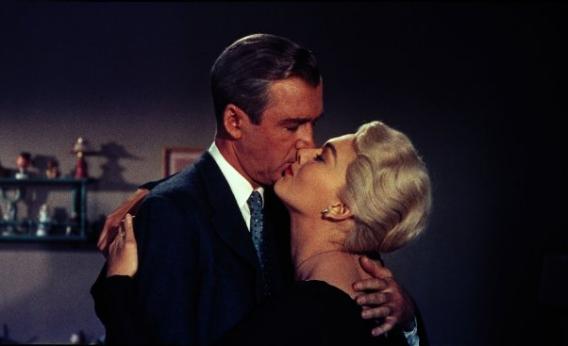
It's ironic that Hollywood produced one of the deeply critical portrayals of 'creativity' when it comes to sex – Hitchcock's great film Vertigo. The main character (played by Jimmy Stewart) is obsessed with a young beautiful woman and feels compelled to control her totally, even to the point of choosing her hair style and clothes. Which is not so different from Weinstein, who also happens to be into fashion in a major way. His (now ex-) wife runs a high end fashion label called Marchesa which does no advertising but which Weinstein promoted through his movie company and connections with the likes of Anna Wintour. After browbeating and/or assaulting and/or raping his victims, he would (some of the time) turn into their Svengali - put them in movies, build their image and (like the Hitchcock character) dress them in designer clothes, the added twist being that the designer was his wife.

Scene from Hitchcock's  'Vertigo'
But comparing Vertigo to Weinstein is like comparing poetry to porn. The sheer number of women 'consumed' by Weinstein, and his host of enablers – staff, agents, business partners, reporters, lawyers with their non-disclosure agreements – add up to an image of an almost impersonal system of sexual degradation. It's hard to imagine that the bodies didn't just become interchangeable after a while. But for the victims the experience couldn't be anything but personal.

Will anything change?

The plausible answer is yes, but not necessarily in a good way. Again, as in the Sixties, efforts will be made to make sex less oppressive. Weinstein's career is ruined, and no doubt other famous names will follow. (Including cases where accusations of abuse become a cover for settling old scores.) For a while powerful men will probably think twice about 'grabbing pussy', as Trump would say. And yet surely the problem goes way deeper than this. Sarah Polley, a talented director and actor, who had her own run-in with Weinstein when she was 19, called him a “festering pustule in a diseased industry.” This is not only an apt description but also a useful diagnosis because it makes evident that bursting a few pustules like Weinstein does not, on its own, clear up the disease.

In this regard, a recurring theme of the stories about Weinstein comes to mind – everybody knew, and if they didn't it was probably because they chose not to. This was true not just about Weinstein but of other big name actors, producers, directors and assorted movers and shakers. Informally there was a kind of 'predator alert' system operating, where women in the movie business would share information about who to avoid, who never to let yourself be caught alone with. This is strikingly similar to the way street prostitutes keep each other informed about dangerous johns – a comparison that says a good deal about the status of women in Hollywood. But there is something else that it says: if everybody knew, that was because it was considered normal for a powerful man to be a sexual predator.

Normal here doesn't mean acceptable. The public discourse was and is all about female 'empowerment'. But another thing that everybody knows in a business like Hollywood is that there are unwritten rules that are far more important than public rhetoric. You learn about them through experience, often with conversations that begin with lines like: Let me tell you how things really are. These unwritten rules are about a different kind of 'empowerment' – the one that comes with money, status, fame. Weinstein had all the power and I had none – this is how some of his victims talked about their feelings of finding themselves suddenly alone with him in a hotel room. This explains why many of the victims remained silent for years, and the same goes for the many more who were 'in the know'.

Or it's part of the explanation. Part of it is also that Weinstein's behavior wasn't seen clearly as predation, even by his victims. Part of it is also that, for some of the women, their sense of how much they 'consented' to was murky (though for the others their sense of being violated was painfully clear).

This power imbalance is the underlying sickness in Hollywood, and not just there. But how likely is that to change? There isn't much meaningful discussion of that in the torrent of coverage over Weinstein. Mostly there are the painful confessions of the victims and contrite apologies from some famous men (usually claiming that they didn't know what was going on and that they will try to do better in the future). There are calls for more female directors and producers, as if we haven't had lots of examples (e.g. more black cops, more female politicians and executives) of how this kind of tokenism changes nothing.

Sarah Polley argues for a change of heart: "I think we need to look at what scares us the most. We need to look at ourselves. What have we been willing to accept, out of fear, helplessness, a sense that things can't be changed? What are we willing to turn a blind eye to, in all aspects of our lives? What else have we accepted that, somewhere within us, we know is deeply unacceptable? And what, now, will we do about it?" These are all good questions but they don't so much answer the problem as pose a new question: where does “fear, helplessness, a sense that things can't be changed” come from?  And once we ponder that question, it eventually becomes clear that a change of heart is never going to be enough. In the immediate aftermath of the 2008 Wall Street crash the bankers and their political hacks were all publicly remorseful, but it's common knowledge that nothing serious has changed and that it's only a matter of time before the same reckless behavior and economic anarchy endemic to capitalism lead to another crash.

To paraphrase a Clinton-era quip, It's the system, stupid. And in Hollywood, the system is not just about greed, it's also about sex. Here I don't just mean what goes on behind the camera but also what goes on in front of it. Can anyone believe that women in Hollywood will be significantly safer off screen so long as their bodies continue to be exploited on screen? In a sense Weinstein was living out the ultimate Hollywood sex fantasy, a dream it's been pandering since the It girls of the silent era. If love means never having to say you're sorry, then Weinstein-type power means never having to take No for an answer. But so long as what goes on the screen doesn't fundamentally change, then neither will the abuses off screen by future Weinsteins. The worst temptation in these circumstances is to imagine that the business of Hollywood will go on as before but that the men (or women) in charge will be nicer to women.

What is called for, then, is a much more radical analysis of the problem. Can we imagine a Hollywood that wouldn't be dependent on sexist images of women? It's so hard to conceive that. We'd have to do away with the label Hollywood itself and talk about rebuilding a new film culture from the ground up. This doesn't mean a return to the Hayes code, which only replaced an overt with a covert fetishizing of female bodies. This is not about censoring sex but about changing its represenations.

***********************************************************
References:

Houellebecq discusses this issue in a number of his novels, but most directly in his first one, whose title, literally translated, is Extension of the Domain of the Struggle. No doubt Houellebecq's English publishers didn't think that would sell, so they replaced it with a throwaway title, Whatever.

Sarah Polley's essay on Weinstein appeared in the NY Times in October: https://www.nytimes.com/2017/10/14/opinion/sunday/harvey-weinstein-sarah-polley.html

Thomas Frank's comment on Weinstein appeared in The Guardian in October: https://www.theguardian.com/commentisfree/2017/oct/21/harvey-weinstein-liberal-world

Lucy's Preeble's comment on Weinstein appeared in The London Review of Books in November: https://www.lrb.co.uk/v39/n21/lucy-prebble/short-cuts


Share:

A question about #MeToo and a brief response

Send to Printer, PDF or Email
Question from Anonymous: What is your opinion of the WSWS's loud opposition to the so-called "me too" movement? 

I think it's consistent with their sectarian politics. They see things in binary terms, not dialectical ones: metoo is reactionary, a witchhunt, neo-McCarthyism, neo-Puritanism etc. The issue of sexual violence against women is mostly discounted. This shouldn't be an either/or proposition. It's possible to be against the overreach of metoo while also being in solidarity with victims of sexual violence; indeed such solidarity is the only legitimate basis for countering the reactionary tendencies of this movement. To read the WSWS is to be left wondering whether the sexual oppression of women even exists.

Frank Brenner
Share:

October Revolution: Dramatic Narrative

Jim Creegan and Marlyn Vogt-Downey present a dramatic narrative of some of the key events of 1917.  The narrative is interspersed with readings from contemporary witnesses including John Reed, Leon Trotsy and Nikolai Sukhanov.  This was a segment of the special broadcast on WBAI radio in New York celebrating the 100th Anniversary of the October Revolution.

Share:

October Revolution: Transcript of Interview with Alexander Rabinowitch

Send to Printer, PDF or Email

Note: This is the transcript of an interview conducted on Nov. 7, 2017 by Alex Steiner (A.S in the interview text) with Dr. Alexander Rabinowitch (A.R. in text). The interview aired on WBAI radio in New Yok on Nov 16, 2017 as part of a 2-hour special broadcast devoted to the October Revolution.
 A link to the audio of the entire broadcast can be found here:
The audio of the interview segment can be found here:

A.S.
In our next segment we go to an interview I conducted with Dr. Alexander Rabinowitch, Professor Emeritus from Indiana University where he taught from 1968 to 1999.  Since 2013 Dr. Rabinowitch has been affiliated research scholar with the St. Petersburg Institute of History, Russian Academy of Sciences. He is recognized internationally as the leading expert on the Russian revolution. His three books on the subject, Prelude to Revolution, The Bolsheviks Come to Power, and The Bolsheviks in Power, are considered by many to be the definitive historical account of the Russian Revolution as it emerged in the key city of Petrograd. Dr. Rabinowitch remains very active, traveling to conferences all over the world and is currently working on another book chronicling the civil war years in Petrograd.

Dr. Rabinowitch it is great to have you with us.  To start off before getting to our main topic I would just like to ask you how you became interested in the Russian Revolution and what motivated you to devote your entire professional career to its study.

A.R.
Sure. My mother and father were Russian. My mother was from Ukraine which was part of Russia when she was born. My dad was from St. Petersburg. They both fled Russia in 1918 during the Red Terror. My dad was then a second-year student at St. Petersburg University, second or third year student. He was Eugene Rabinowitch, quite a famous biochemist but also co-founding editor of the Bulletin of Atomic Scientists. He had been on the Manhattan Project, was very disturbed by the building of the bomb and the implications of the bomb and founded that journal which is still going strong today. He was also a co-founder with Bertrand Russell of the Pugwash conferences of Soviet and American scientists and scientists from other countries also concerned with problems related to the implications of science in the modern world and the potential of science. My dad got his PhD in Berlin and ended up in London where I was born and we moved before the war. My dad got a job at MIT in Boston Massachusetts and I grew up in a Russian immigrant community surrounded by people who had fled the revolution. There people like Alexander Kerensky who I knew, who was the Prime Minister of Russia for much of the Provisional Government period. Vladimir Nabokov, the writer, several leading Mensheviks etc.

Alexander Kerensky
Boris Nicolaevsky
Irakli Tsereteli

A.S.
You knew them personally?

A.R.
Yes. I was fairly young then, but people like Boris Nikolaevsky, who was sort of the archivist of the Social Democrats, was a kind of grandfather to me. He lived in our barn in our summer home in Vermont for years and wrote many of his works there. Irakli Tsereteli, the leading Georgian Menshevik, I remember well. I interviewed Kerensky a couple of times after I got serious about the Revolution. But anyway, I grew up hostile to everything about the revolution. But what sort of transformed me - didn't make me a Marxist, but changed my views on the revolution - was work with Leopold Haimson at the University of Chicago. He was a wonderful teacher and I became seriously interested in the Russian Revolution and as soon as I started working in the sources - and in the newspaper - I very, very quickly changed my views. It was clear to me that the people I had known as a kid and my parents had been forced to leave Russia -understandably, they had been the losers in the struggle for power in 1917- but what came out in the sources was that what had happened in 1917 in Petrograd was a fundamental social and political revolution that fascinated me. That's how I became interested in the subject professionally. Haimson certainly was a very thoughtful social historian, probably on the left but not - I don't think - a Marxist. In any case he was an inspirational teacher and with his help I became fascinated by the subject. And then I was hooked by the material I was finding in libraries and archives and I went to the Soviet Union in 1963-64 and spent the year there working on the July uprising of 1917, mostly in libraries because the archives were closed to Western scholars. More and more I got fascinated by the subject and turned on by putting together bits and pieces and realizing that I couldn't do a photographic picture - that any picture that I did or any historian does is shaped by his background and his or her own views - but I loved trying to come as close as I possibly could to what actually happened.

A.S.
Well you have pretty much devoted your entire professional career to the study of the Russian Revolution and kind of in a microcosm you focus on what happened in Petrograd and there basically only for a period of about a year and a half or so from the July days which was July 1917 on the old calendar till about November 1918 when the first anniversary of the revolution occurred. You broke some new ground by going through original documents to trace in detail the real dynamics of the relationship between the Bolsheviks led by Lenin and the working class and soldiers of Petrograd. In the course of your work you definitively debunked a number of myths about the October Revolution and I'd like to ask you to explain what some of those myths are and how your book debunks them. For instance, there's the myth that the October Revolution was a coup engineered by a tiny group of zealots unconnected to the masses and the associated myth that the masses in turn genuinely wanted the ‘democratic liberal’ regime that was supposedly represented by the Provisional Government. Just this weekend The Wall Street Journal had an article with more or less this theme about the coup of 1917 and the zealots that led it and so on.  Can you explain how your books debunk that myth and what you actually found to be the case?

A.R.
Well first of all I found that what was taking place was from February on was a major social and political upheaval that was very difficult to stop in midstream. I found that far from being the small band of “conspiratorial followers by the numbers” of Lenin in seizing power, from February on the Bolsheviks tried to develop a mass party. They grew enormously among workers and soldiers. They made a great effort to build connections with factory committees in factories and in trade unions getting strength and among garrison troops. More than any other party they were concerned with building roots among the masses and they helped shape mass views but they also were shaped by mass views. The party and in 1917 - far from being a centralized troop movement that - I think it's Applebaum - describes in the Wall Street Journal, they became a mass party and a decentralized party with relatively democratic decision-making and this was terribly important in their success. It almost was catastrophic in July 1917 during the abortive July uprising when the left-wing of the party tried to overthrow the Provisional Government and transfer power to the Soviets too early.  My sense was that Lenin was opposed to that and that was part of the price of having a decentralized party. But in the long run that internal democracy and that decentralization was critical to the party's success. On two or three occasions in July, in September and October, Lenin issued orders to overthrow the Provisional Government which leaders on the spot turned down because they could see that it was very risky and probably doomed to failure with Trotsky helping lead and Lenin giving general directions from his hiding place in Finland they developed a strategy that ultimately led to their coming to power, their successful seizure of power. All the moves against the Provisional government were made in the name of ‘All power to the Soviets’, in the name of ‘Immediate peace’ in the name of transferring power to the Constituent Assembly.  When they came to power they got widespread support precisely because the masses were concerned that there would be another counter revolutionary attempt. There had been one attempt in August - the abortive Kornilov coup - they were afraid of another and they looked at the Bolsheviks not as ‘All power to the Bolsheviks’ -  that was never said - but ‘All power to the Soviets’, multi-party Soviets. What enabled the Bolsheviks to take power by themselves was that the Mensheviks and the SRS and the Menshevik Internationalists all walked out of the second Congress of Soviets that proclaimed the new government. The Left SR’s refused to get into the government with the Bolsheviks and so the Bolsheviks were able to form a government of their own. More and more historians are looking at the revolution - and I got there very early in my work - as a process starting with the February revolution and ending with the Civil War. On the declaration of NEP [New Economic Policy] as one process with the February revolution being a stage of, the July uprising quite likely a stage, with the October Revolution another stage, with the end of the Constituent Assembly another stage et cetera et cetera.  And the civil war is part of it.  Lenin’s seizure power was predicated, as you know well Alex, on the assumption that the revolution in Russia would help trigger worldwide socialist revolution starting in Germany. That didn't occur. One of the things I'm finding - I haven't finished my work - you're right that I have focused very narrowly on a couple of years in my work - but I'm finishing up the third, really a fourth volume on Petrograd during the Civil War and the Bolshevik survival in the Civil War.  And more and more looking at it from that perspective it looks like one major process which takes that long to sort of complete itself. When Lenin saw that his hopes for early socialist revolutions abroad were not happening he declared NEP, the New Economic Policy, which was sort of a partial reversion on an economic plane to sort of state capitalism. ‘Socialism in one country’ is not Lenin as you know Alex.  That was Stalin.

Lenin

Trotsky

A.S.
‘Socialism in one country’ was never dreamed of by any Marxist prior to Stalin. It was kind of this thing where certain measures that were adopted as a result of necessity were turned into a kind of virtue once we get to the Stalin period.

A.R.
I happen to be firmly on the side of the Bukharin camp led by Steven Cohen, who you may know and who is a New York historian and who is Bukharin’s biographer. He had a much less drastic, slower plan for development which, in my view, would have avoided the great tragedy of the Stalin era.

A.S.
Well we can certainly debate all those issues but there's no question that external circumstances forced the Bolsheviks to adopt measures that they originally had no intention of adopting.

A.R.
And I can personally document that for the period October 1917 to 1921. And I do it step by step in the same way that I tried to document what happened in 1917 and 1918. The significant difference is that now I'm able to work in Russian archives.  I work in Russian archives two months every year. I live in St. Petersburg and work in the archives. On this next volume - maybe the last volume, I'm not getting any younger - but I'm able to document processes and developments at a lower level that I never could do without access to archives. And one of the things I found is that in every archive file there is a register of who has used those files going back to when the files were first opened, some of them going back to the 1950s or before, and what I find is that most of them haven't been used or a very high percentage of them haven't been looked at and so what that leads me to believe is we have an awful, awful lot more to learn about the Russian Revolution that we still don't know.

A.S.
Let me just get back to a couple of other myths, for instance the myth that the Bolsheviks spoke in one voice and that basically that was the voice of Lenin. I think your books pretty much destroyed that conception - I mean you're not the only one who's destroyed it - but I think coming from someone of your background with all the scholarship you have available it's very impressive.

A.R.
Well I thank you. Actually, I came to both conclusions initially in the 1960s when both in the West and in the Soviet Union the Communist Party was looked at as a monolith.

A.S.
That myth is a myth that's common to both right-wing opponents of the Russian Revolution and Stalinist apologetics for the regime that came later in the 1930s.

A.R.
Right, and the only point I'm trying to make is that I think I made it fairly early when those things were alive everywhere.  And then it was clear just by looking at the April conference. The April conference, Bolshevik conference, was the first conference after the revolution of the party and Lenin was able to participate. It was sharply divided into a Leninist, a center group and moderate Bolsheviks, right wing Bolsheviks - people like Kamenev and Zinoviev. They fought it out and while Lenin sort of won the main fight regarding the direction of the revolution and the continuation of the revolution and transfer of power to the Soviets, the voice of the moderates was very strong and almost half of the Central Committee were made up of moderates.  And when some people on the Left said ‘Well wait a minute we don't want all those moderates’, Lenin said, ‘No we need them. They have ties to the masses and Kamenev’s voice is important.’ You'll find that in the April conference protocols.  So that Lenin tolerated that lively debate and that lively debate was essential in September when Lenin called for the immediate seizure of power in mid-September. It was way too early - it's clear to all historians now that would have been too early - and a majority of the Central Committee and there was a National Conference in Petrograd at the time - a majority of it voted to ignore Lenin's directives and that was to the good of the party. After the Revolution Lenin more or less conceded it.  And Stalin conceded that Trotsky had been the main leader to voice the tactics that grew out of the situation on the ground.

Bukharin
Kamenev

Zinoviev

A.S.
Why do you think that after your definitive historical account and others this myth of the Bolshevik seizure of power by a fanatical sect and the authoritarian nature of the Bolsheviks and their “inflexibility”, why do these myths still persist?

A.R.
They persist for different reasons in different places. In the West they persist partly - say in the United States - because of hostility to Russia that’s still a product of the Cold War and it's now complicated by these charges of Russian intervention in our electoral system and sort of a gut anti-communism, so that several years ago I remember people like Leo Haimson saying that this was a thing of the past, that mythology.  But I always didn't feel that way and it's come back stronger than ever as was reflected in all of the New York Times' pieces on the revolution in their series and most recently in The Wall Street Journal.  In Russia it's somewhat different. I've been in Moscow and Petersburg several times in the last few months at ‘1917’ conferences, three in Moscow and two in Petersburg and it’s quite clear that at the professional level, among professional historians, serious work is going on and no serious historian is a prisoner of that mythology. But the government, the Putin government, is motivated by a desire for stability and they use nationalism and religious orthodoxy etc., traditional Russian values, implicitly and explicitly, trying to - as we see today - ignore the Revolution and the revolutionary date. They don't want a revolution, understandably - they are another authoritarian regime - and they, that's not in Putin's interest, and so they're helping - sort of encourage – new mythologies.  But I want to emphasize that I'm struck by the way a very politicized topic for the whole hundred years since the revolution among serious Russian historians now has become de-politicized and seriously studied.

A.S.
I note that the Putin regime not only ignored the anniversary of the revolution but they tried to replace it by something called ‘National Unity Day’, which is, I believe, some invention of the Czarist regime that celebrates some uprising against the Poles in the 17th century.

A.R.
Yes, in any case it's not the same day but what you say is true. The Communist Party has tried to organize a few things the last few days but it's very feeble or everything you say is true.

A.S.
To end off, could you say a few words about why it's important for us today to remember the Russian Revolution and are there any lessons for us today about what happened in 1917?

A.R.
Well different people a look at the lessons of 1917 differently. To many Marxist the 1917 revolution, which was the most important event of the 20th century, in the largest country in the world, is an important case study for understanding revolution and making revolution. I just came from a large conference in Brussels day before yesterday. I was there for four days in a workers’ hall in which Lenin spoke in 1914, which was largely populated by devoted communists. and remained communists. And they listen to me very carefully and I know what was in their minds.  You know, what can we learn that might be helpful for me.  It's very different for me.  The Russian Revolution is a terribly important example of why it's important to solve political social and economic problem before they reached a point where a significant percent of the population sees revolution as the only solution to their problems.  But then also, I should add, one needs to have an accurate, sensible view of the revolution. If you look at it as a coup the lesson is very different than if it's a major revolution. The two points of view that I described relate to people who see it as a revolution, one side positively the other negatively.

A.S.
Well I guess on that last question we have to differ a bit because in my view revolutions are unavoidable. But that's a conversation for another time.

A.R.
But let me just hasten to add that I respect that. My job is to present the most accurate picture I can. I think I have support on the left and in the middle precisely because I am NOT ideological and I don't have a cause except one cause, and that's to try to come as close as I can to delivering a sense of what happened and leave it to people like you and friends of mine who are moderates to decide how best to confront it and deal with it.  

A.S.

I appreciate that and I respect your views. Thank you, Dr. Rabinowitch. 
Share:

100th Anniversary of the October Revolution

100th Anniversary of the October Revolution
Listen to special broadcast

ΟΧΙ: Greece at the Crossroads

ΟΧΙ: Greece at the Crossroads
Essays on a turning point in Greece 2014 - 2017

Order ΟΧΙ : Greece at the Crossroads

Permanent Revolution Press

Permanent Revolution Press
Print edition of Crackpot Philosophy

Order Crackpot Philosophy

Trump and the train wreck of American liberalism

Trump and the train wreck of American liberalism
Two essays by Frank Brenner

Order PDF of 'Trump and the train wreck of American liberalism'

PDF of Brenner on Trump -$1

Contact Form

Name

Email *

Message *