


Daniel Lazare
02.19.25
Note
from the editor: We are publishing this essay as the start of an ongoing
discussion and debate on Marxism and philosophy. Readers can expect a response
to this essay shortly.
Note to readers: I wrote this for
Platypus Review, but withdrew it following Platypus founder Chris Cutrone’s
disgraceful embrace of Trump’s aggression toward Canada and Greenland. See “Cheering on Trump,” Jan. 13.
There’s
a rumor going around that the great English political philosopher Thomas Hobbes
(1588-1679) was a conservative. The Nazi
legal theorist Carl Schmitt thought so,[1]
the left-liberal writer Corey Robin does so as well,[2]
while a Maoist website informs us that “Hobbes’
political philosophy’s emphasis on an absolute sovereign is unacceptable for
modern socialists.”[3] By the same token, Hobbes’s verdict on life
in nature as “solitary, poor, nasty, brutish, and short” is
traditionally taken as an expression of anti-social pessimism and misanthropy –
yet more evidence, supposedly, of Hobbes’s conservative leanings.
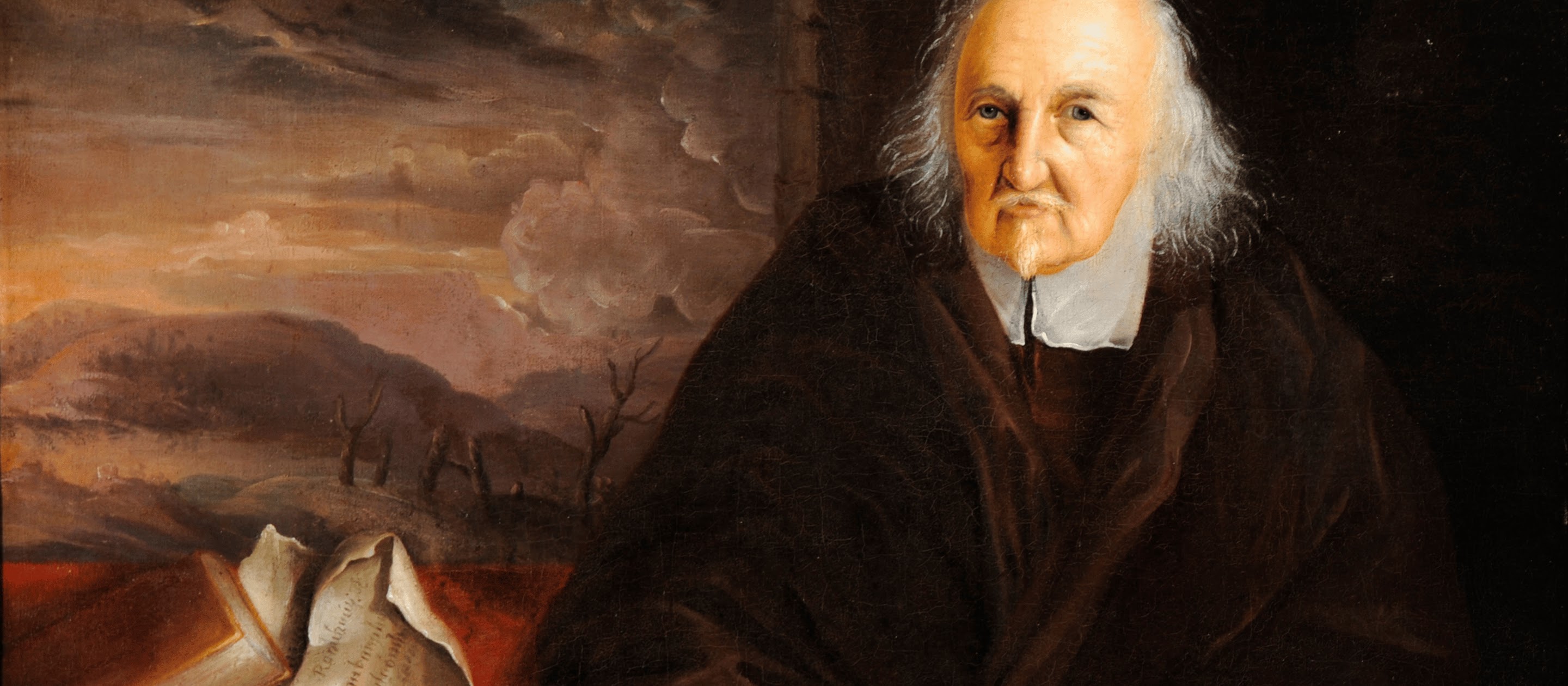 |
| Hobbes at 89 portrait by John Michael Wright |
But it ain’t necessarily so. The reason, simply, is that there is a direct line from the supposedly reactionary Hobbes to the most radical democratic movements of the eighteenth century and after. When Declaration of the Rights of Man stated in 1789 that “[t]he fundamental source of all sovereignty resides in the nation,” it was hard not to hear an echo of Hobbes’s argument concerning the necessity of establishing a monopoly of power. Although there is no evidence that Lincoln read Hobbes, his “House Divided” speech in 1858 not only employed one of the philosopher’s favorite biblical maxims,[4] but replicated his views on the indivisibility of the sovereign state. The same goes for Martin Luther King’s statement in Letter From Birmingham Jail: “Any law that uplifts human personality is just. Any law that degrades human personality is unjust.”
As
students of Hobbes will immediately notice, this is a reiteration of the
Hobbesian principle that sovereignty’s sole concern is its own self-aggrandizement
and hence that any law that enhances human sovereignty is good and that anything
that detracts from it is bad. Whether
sovereignty expresses itself in moral or political terms, whether it concerns
itself with human personality or raw political power, its driving need is for
more, i.e. more domination, more development, more control.
Then there is Trotsky, who declared in his 1920 polemic Terrorism and Communism:
...the road to Socialism lies through a
period of the highest possible intensification of the principle of the
State. And you and I are just passing
through that period. Just as a lamp,
before going out, shoots up in a brilliant flame, so the State, before
disappearing, assumes the form of the dictatorship of the proletariat, i.e.,
the most ruthless form of State, which embraces the life of the citizens
authoritatively in every direction.[5]
While there’s no evidence that Trotsky read Hobbes either, this
can’t help but call to mind his role as a pioneering theoretician of the modern
state. As for the idea that Hobbes’s concept
of absolute sovereignty is somehow at odds with socialist self-governance, Maoists,
as usual, have it backwards. Not only
does Hobbesian absolutism accord with socialism, it lies at its very core.
To be sure, it’s easy to see why people would get Hobbes wrong
since he was an arch-autocrat whose ideas were extreme even by seventeenth-century
standards. He conceived of sovereignty not
just as power or even supreme power, but as the sole power from which all
others derive. Not only would Hobbes
have regarded Louis XIV’s statement, “L’État c’est moi,” as
unobjectionable – he was a fan of the Sun King[6] – he might well have added,
“L’État c’est tout” – the state is all.
A sovereign according to Hobbes does not share power with lesser authorities. He or she does not agree to behave within set
limits. To the contrary, his authority is
permanent and unconstrained – “supreme, irresistible, absolute, uncontrolled,”
in the words of the eighteenth-century legal commentator Sir William Blackstone. It is so complete and self-contained as to
recognize no authority other than its own.
All of which Hobbes set forth in his master work, Leviathan, published while in exile from Cromwellian England in 1651. In it, we learn:
- That
no one can interpret the law other than the sovereign.
- That individual freedom extends only so far as to what “the sovereign has permitted.”
- That sovereignty is incapable of doing wrong because “nothing the sovereign representative can do to a subject, on what pretense soever, can properly be called an injustice or injury.”
- That the sovereign is above the law because “to be subject to laws is to be subject to the commonwealth – that is, to the sovereign representative – that is, to himself, which is not subjection but freedom from the laws.”
While granting the sovereign total control over what people may say or publish, Leviathan – named, by the way for a biblical sea monster in the Book of Job – falls short of modern totalitarianism by specifying that only public behavior is worthy of concern and that whatever one does in private is no one’s business other than one’s own. So there’s no danger of the KGB breaking down the door in search of private notebooks. But it otherwise comes close. According to Hobbes, the individual has no freedom since freedom is solely a sovereign attribute. The sovereign commands while everyone else obeys.
Orwellian? Perhaps.
But why did he take his arguments to such shocking lengths, what made
him think that readers would find them persuasive, and what on earth does Hobbesian
ultra-authoritarianism have to do with socialist democracy?
The
answer to the first is easy: civil war, i.e. the Wars of Religion that ravaged
France from 1562 to 1598, the Thirty Years’ War that
destroyed much of Germany in 1618-48, and the English Civil War that began in
1642 and was still ongoing. The
consequences were catastrophic. France was
still recovering from the chaos by the time Hobbes wrote Leviathan, Germany had lost a third or more of its population,
while fighting was engulfing the three realms of England, Scotland, and
Ireland. Supposedly, Hobbes’s mother was
so frightened by the approach of the Spanish Armada, which would have subjected
English Protestants to a Catholic reign of terror, that she prematurely went
into labor. As Hobbes recalled, “my
mother gave birth to twins: myself and fear.”
But no less important than war was the secular response,
which is to say a new generation of French
politiques who sought to transcend the Protestant-Catholic divide; the 1648
Treaty of Westphalia, which sought a pragmatic and secular solution to the
Thirty Years’ War, and Leviathan itself. Although it was a politique named Jean
Bodin (1530-96) who invented the modern theory of sovereignty, it was Hobbes who
would put it on a far more rigorous footing.
His inspiration was Euclid. While traveling as a tutor to a wealthy English
family, the Oxford graduate found himself in a private library in Geneva in
which a text by the Greek mathematician lay open to the Pythagorean theorem, which
holds that the square of the hypotenuse of a right triangle is equal to the sum
of the squares of the other two sides.
Thunderstruck at how an ancient thinker could use a handful of axioms to
prove something so complicated, he resolved to put politics on an equally solid
footing.
His starting postulate was not only the horrors of civil war
but its necessary concomitant, the absence of authority capable of reining it
in. “Where there is no common
power, there is no law; where no law, no injustice,” Leviathan would declare. “Force
and fraud are in war the two cardinal virtues.”
Labor, investment, and profit were all inhibited. As a consequence:
In such condition there is no place for industry because
the fruit thereof is uncertain: and consequently no culture of the earth; no
navigation nor use of the commodities that may be imported by sea; no
commodious building; no instruments of moving and removing such things as
require much force; no knowledge of the face of the earth; no account of time;
no arts; no letters; no society; and, which is worst of all, a continual fear
and danger of violent death.[7]
Hence
his conclusion about life in such circumstances being solitary and poor – not,
contrary to popular opinion, because human beings are innately vicious, but
because an absence of law leaves even the mildest among them no choice but to resort
to violence in order to defend oneself, one’s family, and one’s
possessions. The problem, as Hobbes put
it, is not that “man
hopes for a more intensive delight than he has already attained to, or that he
cannot be content with a moderate power,” but, rather, that “he cannot assure
the power and means to live well which he has present without the acquisition
of more.” Do unto others before they do
unto you – such is the rule amid a war of “every man against every man.”[8] Hobbes’s thesis is that the more supreme
power stamped out such anarchy, the better off society would be.
All of which may seem logical enough. But given Hobbes’s assumption that royal
absolutism was best suited to the exercise of such power, it fairly begs the
question of how he can be classified as anything other than a conservative, especially
since the mid-1600s saw the
first stirrings of modern democracy on the part of the Levelers, the Puritans
in far-off New England, and other such forces.
How can one squeeze a square peg like Hobbes into the round hole of
democracy at all?
The answer
has to do with certain loose threads that Hobbes was never able to tie up. While Leviathan
assumes that monarchy is best, it allows that an aristocratic or democratic
assembly could exercise sovereignty as well.
Hobbes never explored how such alternatives would work or what effect
they would have on the concept itself. But
the fact that he allowed for the possibility suggests that he didn’t intend for
the concept to be limited to any specific political form.
More
important was his concept of social contract.
This is what he saw as the grand bargain that would allow society to elect
a sovereign guaranteeing the life and safety of all. While this, too, was less than fully worked
out, the implications were paradoxical: the awesome tyranny that sovereignty represents
is not merely something that people would submit to, but something they would democratically
create. Where we tend to think of
autocracy as yielding to democracy, Hobbes saw it as the other way around,
which is to say democracy yielding to autocracy. As James Harrington, the author of the
Cromwellian classic, The Commonwealth of
Oceana, summed it up: “Mr. Hobbes holdeth democracy to be of all governments the first in modern
order of time.”[9]
For
royalists, this was a case of sneaking democracy in through the back door. Even worse was his assertion that not only was
society’s task to place a sovereign on the throne, but to continuously monitor whether
he was still up to the task. As Leviathan puts it: “The obligation of
subjects to the sovereign is understood to last as long and no longer than the
power lasts by which he is able to protect them.”[10] Conservatives were aghast. “The argument that there was a reciprocal
relationship between a government’s protection and a subject’s obedience was
... distinctive and scandalous,” one historian notes.[11] Although Charles II was personally fond of
Hobbes, he came under pressure from hardliners to let it be known that his old
math tutor was no longer welcome in his Parisian court. Since this deprived Hobbes of protection
against French Catholics who detested him even more, his only choice was to
return to England and swear loyalty to the republican government he had previously
opposed.
Hobbes
was the kind of thinker who makes everyone uncomfortable, one with a foot in
both autocratic and democratic camps, or perhaps in neither. Although Charles II welcomed Hobbes back into
his good graces following restoration in 1660, Anglican churchmen continued to
snipe at him for his reputed atheism while John Locke’s Second Treatise of Government, published a decade after Hobbes’s
death in 1679, was, with its theory of limited government, virtually an
anti-Hobbesian polemic from start to finish.
A new generation of radicals viewed him “as an apologist for tyranny, calumniator of republican
assemblies, champion of censorship, and a thinker who had drawn an excessively
pessimistic picture of natural humanity,” to quote the intellectual historian
Jonathan Israel.[12]
His fate seemed clear. However interesting
and provocative his ideas, he would pay a growing price for being increasingly out
of step with the times.
But a
funny thing happened on the way to intellectual eclipse: the loose threads in
Hobbesian ideology came together in a new and unexpected way as democracy emerged in more militant form. Rousseau was fiercely hostile, describing
Hobbes’s concept of sovereignty as a means of extracting
slavery from liberty. But Emmanuel
Joseph Sieyès was a straight-out Hobbesian of the most unabashed sort. Sieyès, a free-thinking clergyman, was a key
figure since his 1789 pamphlet “What Is the Third Estate,” virtually invented
the modern bourgeois-democratic state.
Indeed, entire passages read as if they were lifted straight out of Leviathan, except that it was now the
people or the nation – terms that Sieyès viewed as synonymous – that were sovereign
rather than a king.
“The nation is
prior to everything,” the pamphlet declares. “It is the
source of everything. Its will is always
legal; indeed, it is the law itself.” It
continues:
The power
exercised by the government has substance only in so far as it is
constitutional; it is legal only in so far as it is based on the prescribed
laws. The national will, on the
contrary, never needs anything but its own existence to be legal. It is the source of all legality. ... Let us not be afraid of repeating it: a
nation is independent of any procedures; and no matter how it exercises its
will, the mere fact of its doing so puts an end to positive law, because it is
the source and the supreme master of positive law.
Where
Hobbes thought of sovereignty and society as separate and distinct, “What
Is the Third Estate” marked the start of a
process of convergence that would unite them in one. Where formerly only the king was free, it was
now popular sovereignty that was free to govern the people as it saw fit.
This did not make the doctrine any less tyrannical. If anything, it made it more so. Formerly, even an autocrat like Louis XIV had
struggled to transform France from a patchwork of provincial customs and
privileges to something more centralized and uniform. Yet he failed to the point that, following
his death in 1715, France found itself in the grips of a full-blown aristocratic
reaction in which provincial privileges were once more on the ascendant. Yet the new constituent assembly that took
power in 1789 abolished such privileges at a stroke by doing away with age-old
provinces like Normandy and Brittany and replacing them with uniform départements. It was rather as if the Constitutional
Convention in Philadelphia had abolished Virginia, Pennsylvania, and New York
and replaced them with uniform administrative districts. The regional law courts known as parlements were strongholds of aristocratic
power that had also hampered the crown at every turn. Yet a few months after sweeping away the
provinces, the constituent assembly swept them away too. Where previously the parlements were a constituent element
that shaped the ancien régime, the
new super-Hobbesian society reduced such elements to just one: the people.
The new Hobbes turned the old Hobbes on his head – or on his
feet. Simultaneously, it tied up the
loose threads that Hobbes had left hanging.
Try as one might, it was hard to imagine how showering Louis XIV with
ermine and silk might benefit the beleaguered French peasantry. But now that the people were sovereign, it
was clear how they would benefit by the concentration of absolute power in
their hands. As a good Puritan, Hobbes had
described God as “sovereign
of sovereigns.”[13] But how could multiple infinite powers rule
simultaneously even if they were as far apart as heaven and earth? As divided as Jacobins were on the religious
question, the revolution opened the door to a new concept of “storming the
heavens” in which revolutionaries resolved to overthrow divine sovereignty so
that human sovereignty might flourish.
The new Hobbes also shed light on
what might be described as the “e pluribus unum” problem. Declared Leviathan:
A multitude
of men are made one person when they are by one man, or one person,
represented; so that it is done with the consent of every one of that multitude
in particular. For it is the unity of
the representer, not the unity of the represented, that maketh the person one.
A formless aggregate thus transformed
itself into a unified entity in the course of creating a sovereign power to
rule over it. Its unity depended on the
unity of the sovereign. For Sieyès, who defined the people as “a
unity capable of constitutive action,” many became one by constituting
themselves as a sovereign force. Rather
than unity without, they short-circuited the process by creating it
within. Not only were they sovereign
over society, but they were sovereign over themselves.
Self-constitution, self-transformation, self-sovereignty –
all began to stir with the great bourgeois-democratic revolution of 1789. Then there is socialism. Obviously, Marxism does not believe in the
social contract other than in the most abstract metaphorical sense. But when the Communist Manifesto declared
that “[t]he proletarian movement is the self-conscious, independent movement of
the immense majority, in the interest of the immense majority,” what it was
saying, in effect, was that the task before the working class was to remove
sovereignty from the bourgeois state and make it its own. Where the manifesto declared that “the free
development of each is the condition for the free development of all,” it implied
that the Hobbesian converse was also true, which is that the free development
of all is the condition for the free development of each. If man is to “revolve about himself as his
own true sun,” it means that humanity must assert its sovereignty
over society, nature, and itself so as to collectively address its own needs
and wants.
The state withers away to the degree that human society and sovereignty merge
so completely that each disappears as a separate element. External coercion vanishes the more
collective self-discipline is fully internalized.
The idea that Hobbes is somehow at odds with socialist
self-governance is therefore nonsense.
Communism is human self-sovereignty raised to the highest degree.
As for Terrorism and
Communism, which Trotsky says he wrote
“in the car of a military train ... amid the flames of civil
war,”[14]
the book is nothing if not controversial since, rather than apologizing for the
militarization of labor and other draconian policies, it celebrates them. As Trotsky put it:
...we are making the first attempt in
world-history to organize labor in the interests of the laboring majority
itself. This, however, does not exclude
the element of compulsion in all its forms, both the most gentle and the
extremely severe. The element of State compulsion not only does not disappear
from the historical arena, but on the contrary will still play, for a
considerable period, an extremely prominent part.
To be sure, Trotsky stressed that “[i]f compulsory labor came
up against the opposition of the majority of the workers, it would turn out a
broken reed, and with it the whole of the Soviet order.” The militarization of labor therefore had to
be “by the will of the workers themselves.”
But militarization is still militarization, so it still raises the
question of how a society in which compulsion plays “an extremely prominent
part” can lead to one in which it plays no part at all.
As Hobbes might have replied – had he freed himself from
Christianity, private property, and all the rest – the establishment of
proletarian sovereignty is the first task.
Democracy must lead to the proletarian dictatorship, “the most ruthless
form of State,” which in turn must lead to socialism the more class rule is
democratized. But just as the sovereign’s
first duty is to its own self-aggrandizement, revolution’s first duty is to its
own survival.
Like Hegel, Hobbes is an example of a thinker who helped
propel bourgeois ideology in the direction of revolutionary democracy and then
socialism. Marx, who did read Hobbes, paid
tribute to him and his fellow materialists.
As “[g]eometry
is proclaimed the cardinal science,” he wrote in 1845, “...materialism is
rationalized, and it develops also the ruthless logicality of reason.” He went on:
It
needs no special ingenuity to discover in the doctrines of materialism
(concerning the natural goodness and the equal mental endowments of man, the
omnipotence of experience, habit, and education, the influence of external
circumstances on man, the great importance of manufactures, the legitimacy of
enjoyment) the necessary connection with Communism and Socialism. If man receives from the external world and
from his experience in the external world all his feelings, ideas, etc., then
it is evidently our business to reorganize the empirical world in such a manner
that man should only experience the really humane and acquire the habit of it.
... If man is formed by circumstances,
then we must humanize the circumstances. If man is social by nature, then man develops
his true nature in society only, and we must not measure the power of his
nature by the power of a single individual, [but] by the power of society.[15]
The royal “we” becomes
the proletarian “we” under socialism as workers “humanize the circumstances and
empower society.” Society taking control
of itself in order to transform itself – this is the process that Hobbes first
glimpsed in 1651. The task of
revolutionary socialism nearly four centuries later is to carry the same
process through to completion.
[1] In 1938, Schmitt identified
his fate with the “lonely philosopher from Malmesbury,” whom he described as
“lonely as every pioneer; misunderstood as is everyone whose political thought
does not gain acceptance among his own people; unrewarded, as one who opened a
gate through which others marched on....”
Carl Schmitt, The Leviathan and the State Theory of Thomas Hobbes:
Meaning and Failure of a Political Symbol, trans. G. Schwab and E. Hilfstein (Westport: Greenwood Press.
2004), 86. See also R. Omur Birler, The Leviathan and the Contours of
Conservative Imagination: The Role of Thomas Hobbes in the Works of Schmitt,
Strauss and Oakeshott (Ottawa: Carlton Univ. Ph.D. thesis, 2007), 75.
[2] Corey Robin, “The First
Counter-revolutionary,” The Nation, Sept. 30, 2009, https://www.thenation.com/article/archive/first-counter-revolutionary/.
[3] Carlos L. Garrido, “Thomas Hobbes
– The Communist?” Midwestern Marx Institute, July 7, 2021, https://www.midwesternmarx.com/articles/thomas-hobbes-the-communist-by-carlos-l-garrido.
[4] Thomas Hobbes, Leviathan (Indianapolis: Bobbs Merrill,
1958), 150. See also Mark 3:25, Matthew
12:25, and Luke 11:17.
[5] See chapter eight “Problems of the
Organization of Labor.”
[6] James J. Hamilton, “Hobbes the
Royalist, Hobbes the Republican,” History
of Political Thought 30, no. 3 (Autumn 2009), 419.
[7] Hobbes, Leviathan. 107-08.
[8] Ibid., 86, 106.
[9] Jonathan I. Israel, Enlightenment Contested: Philosophy,
Modernity, and the Emancipation of Man 1670-1752 (Oxford: Oxford Univ.
Press, 2006), 226.
[10] Ibid., 179.
[11] Timothy Raylor, “The Anglican Attack on Hobbes in
Paris, 1651,” The Historical Journal
53, no. 1 (March 2010), 159.
[12] Israel, Enlightenment Contested, 226.
[13] Hobbes, Leviathan, 266.
[14] L Trotsky, The Defence of Terrorism (London: Routledge, 2014), i. The quote is from an introduction to a new
British edition of Terrorism and
Communism that Trotsky wrote in 1935.
[15] The Holy Family (1845), available
at https://www.marxists.org/archive/marx/works/1845/holy-family/english-materialism.htm.




